Clitoral Facts
Things to Know About the Clitoris
Both physically and spiritually, the vulva is the gateway to life. Yet at the same time, it is also the source of mystery and misconception.
Since has been analysing women’s bodies for 2.000 years in an attempt to understand the mechanics of female pleasure. The first accurate illustrations of the organ date back to 1672 by the Dutch anatomist Reinier de Graaf. His drawings were based on a discovery by the Italian surgeon Realdo Colombo. In the 16th century, he discovered a new organ: “the Amor Veneris – the love of Venus”. He described his discovery as a “perfect organ of female pleasure”.
Even today, very few people can tell the difference between the vulva and the vagina. And not just men: less than 30 % of women even know what a vulva is.
It’s actually quite simple. The vulva is on the outside – it includes the mons pubis, the labia majora and minora and the clitoris. The vagina is on the inside. It is a flexible muscular canal, about ten to twelve centimetres long.
The Clitoris Is an Iceberg
90 % of the clitoris lies inside the body. Only the tip, the so-called clitoral glans, is visible. There are around 8.000 nerve endings on it, which is about two to three times as many as on the glans of the penis. Because only the clitoral glans is visible to the naked eye, it was dismissed in ancient Greece as the “mole’s eye”: atrophied and useless. An absolute fallacy.
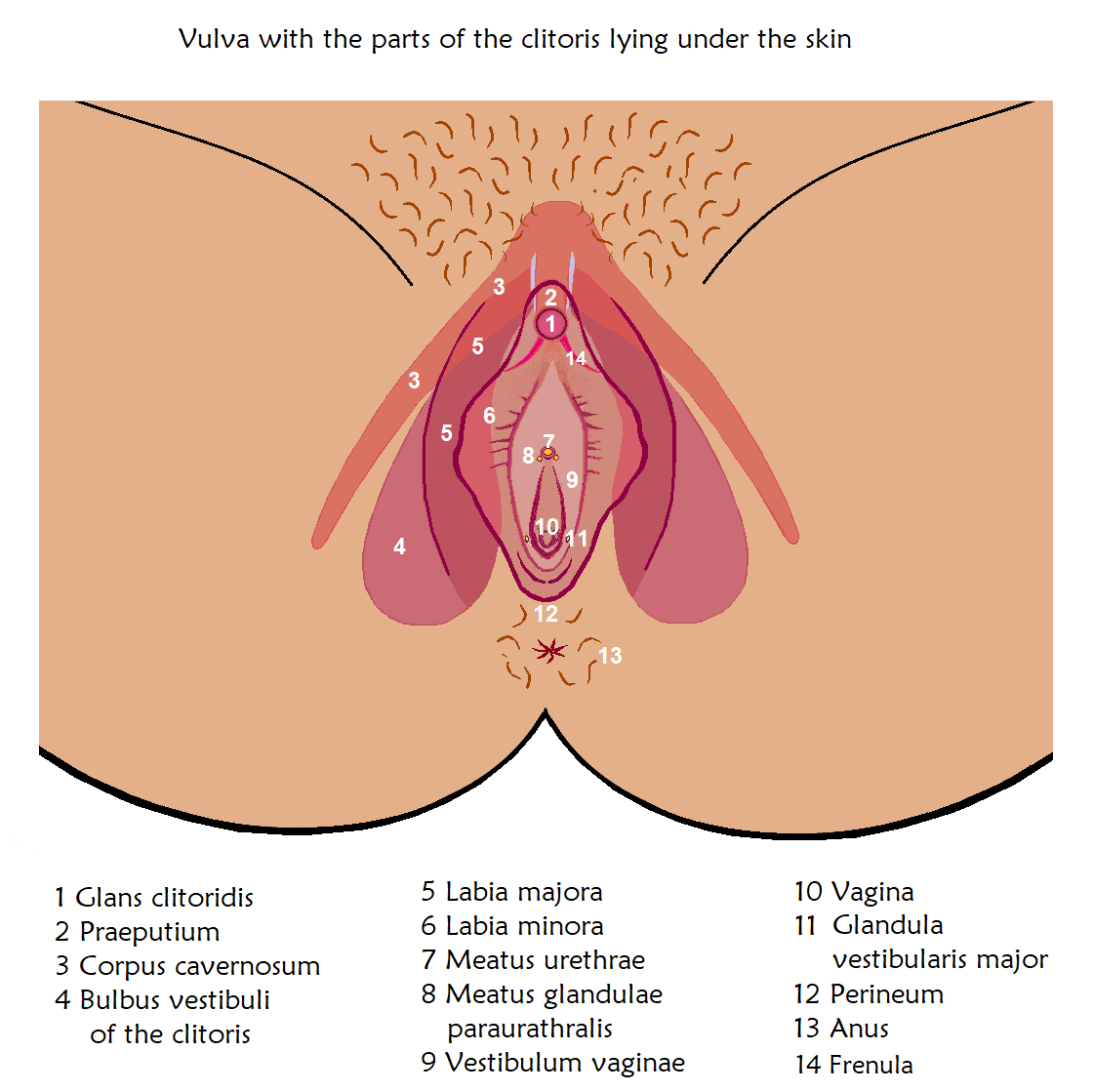
Anatomy of vulva and clitoris (Wikimedia Commons)
The Clitoris Is up to Twelve Centimetres in Size
Every second train station is decorated with penises, but very few people know what a clitoris looks like. That’s no wonder because not even our schoolbooks get it right. They still refer to the clitoris as pea-sized and dot-shaped. This is highly inaccurate and outdated information from the early 20th century. In fact, the clitoris can be up to 13 centimetres long. The fact that it is even larger than the average erect penis (in some countries) was observed by Helen O’Connell, a urologist from Australia. At the end of the 1990s, while dissecting a corpse, she discovered that the clitoris, with its 12 centimetres, is about ten times as large as depicted in standard anatomical literature.
In the Beginning, We Are All Female
Long before Realdo Colombo discovered it as a new organ, the clitoris was thought to be nothing more than an evolutionary remnant of the penis.
In fact, in human development, it is the other way around. We are all female in the womb first. Every foetus has the same bulge between its legs for the first few weeks. It is only through the influence of testosterone in the 5th week of pregnancy that the genital bump develops into a penis instead of a clitoris.
Because it develops from the same erectile tissue as the penis, the clitoris must be considered the primary female sexual organ. Not the vagina or vulva.
The Clitoris Swells During Arousal
The closer women get to orgasm, the more the clitoris and all its parts swell – up to 300%. Again, there are similarities between the penis and the clitoris: both have a flaccid and an erect state.
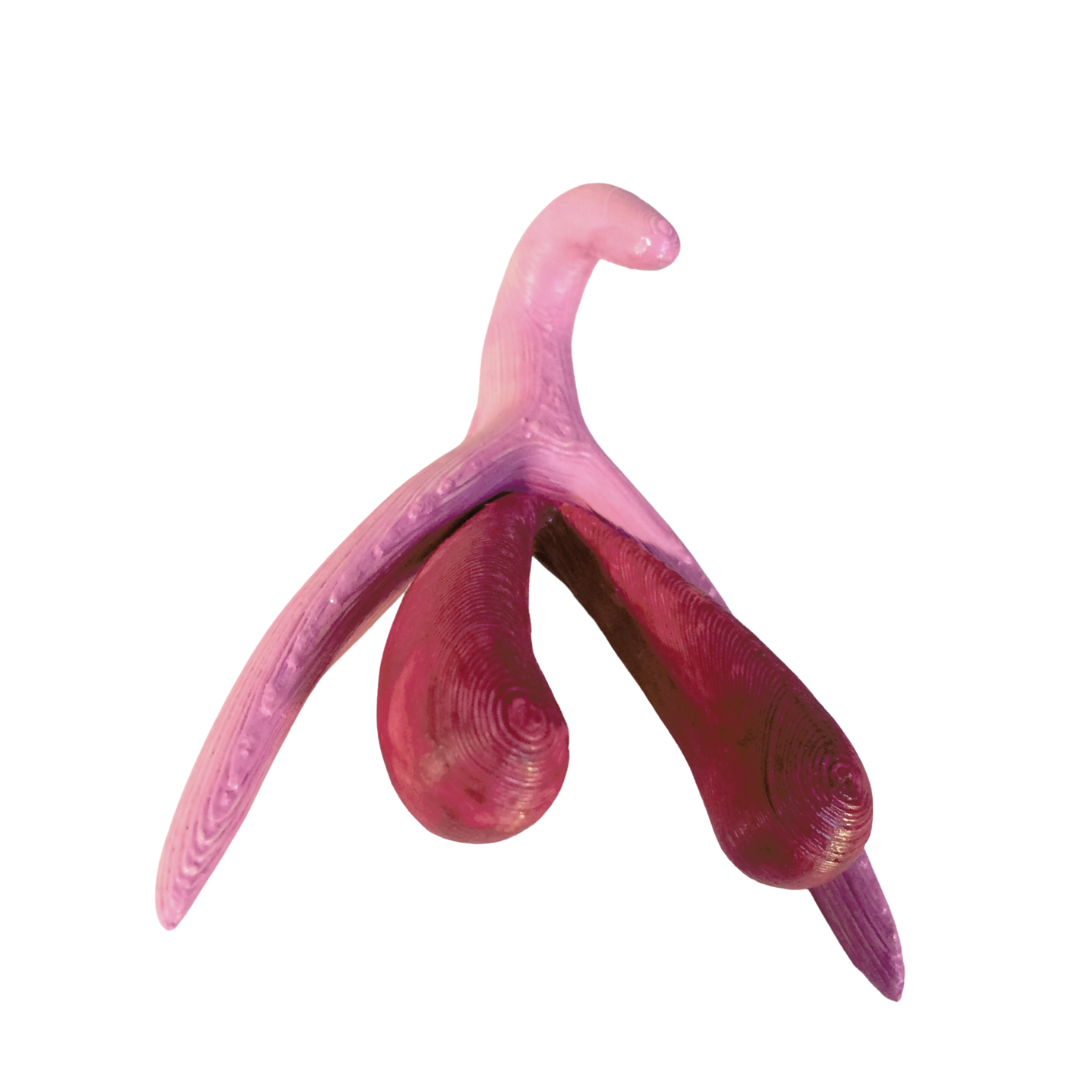
Model of the clitoris (Wikimedia Commons)
The Clitoris Does Not Age
The clitoris is the only part of the human body that does not age. Whether you are 18 or 81, the clitoris functions the same. It continues to grow throughout life and can be up to 2.5 times larger in old age than when you were younger.
Every Orgasm Is (Also) Clitoral
Not even a quarter of women can reach orgasm through vaginal penetration alone. In fact, studies suggest that there is no such thing as a purely vaginal orgasm. Because: During vaginal penetration, the clitoris is always stimulated by the vaginal walls as well.
The G-Spot Is on the Back of the Clitoris
This brings us to the next amazing fact. If every female orgasm is also a clitoral orgasm, this means that the G-spot is not located at the back of the vagina, as is commonly thought, but on the underside of the clitoris. In fact, the vagina and clitoris are strongly intertwined. The side walls of the vagina are lined with countless blood vessels that swell when aroused. This is known as the vaginal plexus. This plexus – together with the nearby fused clitoris and the branches of the erectile tissue – are important in producing vaginal lubrication.
© Philipp, 14 June 2022